Tonight was the Presidents Conference hosted by Shimon Peres, the President of the State of Israel. http://www.presidentconf.org.il/en/
Our program was the only gap year program through MASA Israel (the overhead company that supports and offers grants to many, many programs in Israel) that was invited to the conference.
The people there that spoke included BB Netanyahu, the Prime Minister of Israel, Shimon Peres, Tony Blair, Mort Zuckerman, as well as a video greeting from President Obama.
There were many other foreign dignitaries that were in attendance, but didn't speak, including
All in all it was amazing, each speaker was very interesting, and very intense, although for Shimon Peres and BB Netanyahu some of the inflection and emotion were lost because I had to listen to a translator, and they translator was not very deep with her emotional use.
Between the speakers Israeli musicians such as Idan Raichel, who we actually met prior to the conference starting (A fantastic performer that we're going to be seeing on Sunday) and a childrens choir sang.
The Conference was fantastic, and there is a small chance we're going to be able to return tomorrow for other aspects and talks of the conference, but it is unclear as to what portions of the event we're allowed to attend.
It was incredibly unreal that we were sitting in the same building and listening to these political speakers live, even those who I didn't have much background on were still amazing to listen to, and I am seriously in awe.
Wednesday, October 21, 2009

Sunday, October 18, 2009
Sunday Adventure In Jerusalem
So, as I said in the last post, every Sunday is reserved for trips in and around Jerusalem and this Sunday the original plan was to go to the Dome of The Rock, but due to current tensions surrounding that location, we had to make other plans.
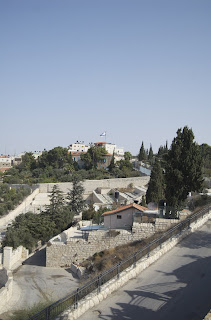 From there we went to King David's tomb, where this sort of crazy old Hebrew woman told us all of these tips about how to achieve a "successful" life. On her list was; find a husband, wear plastic bags around your white socks, because it will not only prevent warts but will keep your socks clean, thus making you more religious, as well as some other tips. We also went to the room where the supposed last supper took place, although it is purely speculation that the last supper occurred in that exact location.


He talked to us about his efforts in resolving conflicts between Muslims and Jews. It was very interesting, he talked about talking to certain leaders, and trying to get them to see and understand the value of coexistence, and he shared some personal experiences. All in all it was a very interesting day.
We started the day by going to the Mount of Olives, which had a gorgeous view of Jerusalem. For those who may not know, the Mount of Olives cemetery is one of the largest in Israel, because it is said that when the Messiah comes and all the righteous are resurrected, those buried at the Mount of Olives cemetery will be first because that's where the Messiah will appear.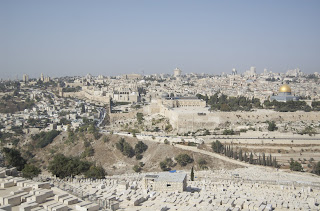
Views from Mount of Olives
 From there we went to King David's tomb, where this sort of crazy old Hebrew woman told us all of these tips about how to achieve a "successful" life. On her list was; find a husband, wear plastic bags around your white socks, because it will not only prevent warts but will keep your socks clean, thus making you more religious, as well as some other tips. We also went to the room where the supposed last supper took place, although it is purely speculation that the last supper occurred in that exact location.
It is agreed by historians that the last supper took place on the second story of a building, and most likely in the same neighborhood as the place that we visited. But the building we were at was only a thousand years old, not two thousand, which is what it would need to be if this was the exact location. Regardless, it was pretty cool.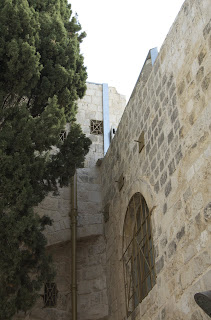
View from outside of King David's Tomb
From there we went to the roof of a nearby Yeshiva. The Yeshiva was essentially at the Western Wall, and had a fantastic view of the Dome of the Rock. There, one of the people who worked for the Yeshiva talked to us, but pretty much all he had to say was pro-Israel, pro-Jewish propaganda about how the Dome of the Rock originally belonged to the Jewish people, and how much larger the second temple was originally and how all of these other factors and people have only left the Jewish people with a small remnant, and how the Western Wall isn't actually the most sacred spot, the Dome of the Rock is, due to it being where the inner sanctum of the second temple was. Anyways, it got a little ridiculous by the end. I mean, it was interesting to hear, but it was completely one sided, and biased.
Views From the Roof of The Yeshiva, Over looking the Dome of the Rock and the Kotel


Glass Sculpture inside the Yeshiva
After this we had lunch in the Jewish quarter and walked back to Beit Schmuel, and then we had a discussion with a man named Ghassan Mansara, who is an Arab Sufi Shikh He talked to us about his efforts in resolving conflicts between Muslims and Jews. It was very interesting, he talked about talking to certain leaders, and trying to get them to see and understand the value of coexistence, and he shared some personal experiences. All in all it was a very interesting day.
Friday, October 16, 2009
Almost A Week In Jerusalem!
So, we've been in Jerusalem since last Sunday.
We arrived in the city and stopped at the overlook (the first place we went on the synagogue trip), as a bonding activity as a group. It was beautiful, although a lot us just wanted to get to Beit Schmuel (the HUC dorm where we live) and settle in.
At about three in the afternoon we arrived at Beit Schmuel, got our roommates and keys and began, finally, to unpack our suitcases.
My roommates names are Tanya and Sara, they both went to school in NYC. One lives in the city on the Upper West Side and the other is from Great Neck. They're both very nice.
Pictures of my room will be coming, but i can describe it a little bit. It's a hostel room, and it has three sets of bunk beds, though the top beds fold up on to the wall, so up and out of the way. All three of us in the room really like orange, Sara and I have orange sheets on our beds, and Tanya has a bright orange blanket. It makes the room really bright. Other than that, there are two drawers under each bed, and a closet that the three of us share. We have our own bathroom, with a room for the toilet and a room for the shower, as well as one desk for the three of us. All in all, it's pretty good, there isn't an enormous amount of space, but it could be much much worse.
Daily/Weekly life in Jerusalem:
We take four classes: Hebrew (I'm in level 1)
Arabic, everyone is in the same level, although there are two different classes, Civilizations; which is the course to help us learn about all the countries we are going to be visiting: their history, culture and some modern day information
Middle East: Where we'll focus on understanding the countries surrounding Israel, their beliefs, religions, customs, etc. in order to try and better understand the social conflict.
Monday: We have classes. Hebrew and Arabic in the morning then lunch, then our civilizations course, then some free time, then dinner, then our Middle East Course then a group activity.
Tuesday: Tuesday is our social responsibility day. We are all required to take part in a community service project in around the city of Jerusalem. I, along with four other girls from KIVUNIM are going to be working at Weezo, which is a battered women's shelter up the street in Jerusalem. Right now all we're doing is sorting clothing (they operate a sort of thrift store for women who don't have a lot of money) but the hope is to be able to meet with the women over the course of the year.
Wednesday: Is another class day; Hebrew and Arabic in the morning, a group activity, a large chunk of civilization classes, dinner and then a night out to do what we want in Jerusalem.
Thursday: Hebrew and Arabic in the morning, lunch, and then Middle East in the afternoon, then dinner and sometimes a group activity and sometimes time to do what we want in Jerusalem.
Friday: Fridays are always free
-Once or twice a month we have free weekends, so from Thursday after programing to Saturday night, we are free and can do whatever we want within Israel.
When we have non-free Shabbats or Shabbat byachad (together) Fridays may include a small amount of programing, for instance, going to the Shuk, or some other market within Israel.
Saturday: Saturdays are always very relaxed; although this program does not associate with any particular denomination of Judaism it respects all beliefs, so for those who may want to keep Shabbat the program respects their beliefs and does not schedule activities that would make them compromise Shabbat.
-There are a fair number of modern orthodox students on this trip; more than I honestly expected, although only one of them observes Shabbat
-A good portion of the students are conservative
-There is a small number of Reform students, and that is certainly the minority.
-There are also a couple students who either do not associate themselves with one of the denominations.
The surprising thing here though is that the overwhelming the majority of students have gone to Jewish Day School their entire lives, and if they haven't gone their entire lives then they at least went through 8th grade. There are maybe six students out of 47 who went to public school at any point in their lives.
Sunday: Sundays are always reserved for group programing in Israel. The goal of Sunday excursions are to deepen our understanding and knowledge about what we're studying within our classes. So that may mean, going somewhere that we can learn something about the next country we're going to visit which connects to our civilization course. Or going to other religious sites in and around Jerusalem, whether that be a mosque or a church or something else, in order to increase our awareness of the social conflict.
That's our typical week while we're in Jerusalem, when we go to other countries it will be more like orientation with constant programming and group activities.
We arrived in the city and stopped at the overlook (the first place we went on the synagogue trip), as a bonding activity as a group. It was beautiful, although a lot us just wanted to get to Beit Schmuel (the HUC dorm where we live) and settle in.
At about three in the afternoon we arrived at Beit Schmuel, got our roommates and keys and began, finally, to unpack our suitcases.
My roommates names are Tanya and Sara, they both went to school in NYC. One lives in the city on the Upper West Side and the other is from Great Neck. They're both very nice.
Pictures of my room will be coming, but i can describe it a little bit. It's a hostel room, and it has three sets of bunk beds, though the top beds fold up on to the wall, so up and out of the way. All three of us in the room really like orange, Sara and I have orange sheets on our beds, and Tanya has a bright orange blanket. It makes the room really bright. Other than that, there are two drawers under each bed, and a closet that the three of us share. We have our own bathroom, with a room for the toilet and a room for the shower, as well as one desk for the three of us. All in all, it's pretty good, there isn't an enormous amount of space, but it could be much much worse.
Daily/Weekly life in Jerusalem:
We take four classes: Hebrew (I'm in level 1)
Arabic, everyone is in the same level, although there are two different classes, Civilizations; which is the course to help us learn about all the countries we are going to be visiting: their history, culture and some modern day information
Middle East: Where we'll focus on understanding the countries surrounding Israel, their beliefs, religions, customs, etc. in order to try and better understand the social conflict.
Monday: We have classes. Hebrew and Arabic in the morning then lunch, then our civilizations course, then some free time, then dinner, then our Middle East Course then a group activity.
Tuesday: Tuesday is our social responsibility day. We are all required to take part in a community service project in around the city of Jerusalem. I, along with four other girls from KIVUNIM are going to be working at Weezo, which is a battered women's shelter up the street in Jerusalem. Right now all we're doing is sorting clothing (they operate a sort of thrift store for women who don't have a lot of money) but the hope is to be able to meet with the women over the course of the year.
Wednesday: Is another class day; Hebrew and Arabic in the morning, a group activity, a large chunk of civilization classes, dinner and then a night out to do what we want in Jerusalem.
Thursday: Hebrew and Arabic in the morning, lunch, and then Middle East in the afternoon, then dinner and sometimes a group activity and sometimes time to do what we want in Jerusalem.
Friday: Fridays are always free
-Once or twice a month we have free weekends, so from Thursday after programing to Saturday night, we are free and can do whatever we want within Israel.
When we have non-free Shabbats or Shabbat byachad (together) Fridays may include a small amount of programing, for instance, going to the Shuk, or some other market within Israel.
Saturday: Saturdays are always very relaxed; although this program does not associate with any particular denomination of Judaism it respects all beliefs, so for those who may want to keep Shabbat the program respects their beliefs and does not schedule activities that would make them compromise Shabbat.
-There are a fair number of modern orthodox students on this trip; more than I honestly expected, although only one of them observes Shabbat
-A good portion of the students are conservative
-There is a small number of Reform students, and that is certainly the minority.
-There are also a couple students who either do not associate themselves with one of the denominations.
The surprising thing here though is that the overwhelming the majority of students have gone to Jewish Day School their entire lives, and if they haven't gone their entire lives then they at least went through 8th grade. There are maybe six students out of 47 who went to public school at any point in their lives.
Sunday: Sundays are always reserved for group programing in Israel. The goal of Sunday excursions are to deepen our understanding and knowledge about what we're studying within our classes. So that may mean, going somewhere that we can learn something about the next country we're going to visit which connects to our civilization course. Or going to other religious sites in and around Jerusalem, whether that be a mosque or a church or something else, in order to increase our awareness of the social conflict.
That's our typical week while we're in Jerusalem, when we go to other countries it will be more like orientation with constant programming and group activities.
Tuesday, October 13, 2009
The third stop of Orientation
Day 6: So that morning we left Stay Boker and headed to Ketura. We all settled in for a pretty long drive and slept most of the way there. We arrived on the Kibbutz and met our tour guide as well as woman named Leah who had been there almost since the founding of the Kibbutz. This Kibbutz was founded by a group of students back in the 1970's who spent a year after high school on Young Judea's year course. The loved the country, returned to the U.S to get support for their idea (to found a Kibbutz) made Aliya, went through the Army then founded the Kibbutz. So we watched a video about the day the Kibbutz was founded and learned about the founders. Interesting Fact: None of the original founders still live on the Kibbutz. All but one are still alive (one died in a car accident) but the rest have moved away from the community. After this we had lunch, and some relaxation time, and then another hike! This one was up a nearby mountain, but the terrain was very very steep, and one wrong step could have sent someone to a very sorry end. We ended up leaving for the hike a little later than planned, and had to hike that last portion of it as the sun was setting. Then we had a barbecue planned for us by the Kibbutz as well as time to swim, although the water was pretty cold, and no wanted to get in.
Day 7: The next morning we woke up very early to begin a three hour hike that would take us to the top of a mountain from which you could see Jordan, Saudi Arabia, Egypt and of course Israel. The hike on the way up was pretty easy, it was more getting down this very rock mountain that took time, concentration and effort. But the view from the top was awesome. It was also the last day of Sukkot, so we shook the lulav and etrog from the top.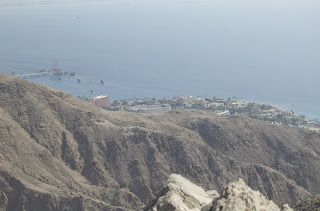

Day 7: The next morning we woke up very early to begin a three hour hike that would take us to the top of a mountain from which you could see Jordan, Saudi Arabia, Egypt and of course Israel. The hike on the way up was pretty easy, it was more getting down this very rock mountain that took time, concentration and effort. But the view from the top was awesome. It was also the last day of Sukkot, so we shook the lulav and etrog from the top.


views from the top of the mountain overlooking several countries
Later that day we returned to the Kibbutz to get ready for shabbat, and Simchas Torah. Simchas Torah on the Kibbutz was an incredibly joyous and very very spirited celebration, with hours and hours of dancing, and singing, and punch and food, and all around fun. They repeated a certain portion of the prayers seven times, and each time took probably twenty minutes with all the dancing and such, so it got a little tiring by the end, but it was certainly a really engaging and exciting thing to be able to see and be a part of. Then was Shabbat dinner with the entire Kibbutz. It felt a bit like camp, all sitting around waiting for the chicken to be passed down the table. But don't worry, I'm still a vegetarian, there are plenty of foods to eat here. And lots and lots of vegetables. But back to Shabbat, after Shabbat we all just hung out.
Day 8: Shabbat morning services were not mandatory but it was mandatory that we go to Kiddush around 11. When we showed up for Kiddush though, there were still in the midst of round 4 or 5 of the Simchas Torah dancing and singing and it was quite a while before they took a break for Kiddush, let alone finished the service. We had lunch at one, and they were still going. After lunch was just hang out time, and some group activities, and then later that night, it was scheduled that the entire KIVUNIM group go to the Kibbutz pub. Before there are shocked minds: it's Israel, and being 18 means being legal.
Day 9: The next morning we left Ketura and headed to Jerusalem!
Day 8: Shabbat morning services were not mandatory but it was mandatory that we go to Kiddush around 11. When we showed up for Kiddush though, there were still in the midst of round 4 or 5 of the Simchas Torah dancing and singing and it was quite a while before they took a break for Kiddush, let alone finished the service. We had lunch at one, and they were still going. After lunch was just hang out time, and some group activities, and then later that night, it was scheduled that the entire KIVUNIM group go to the Kibbutz pub. Before there are shocked minds: it's Israel, and being 18 means being legal.
Day 9: The next morning we left Ketura and headed to Jerusalem!
A Continuation of Orientation
In order to limit the extensiveness of one post, and to not make it drag on and on, I figured I split up orientation into at least a few posts.
Okay, so the last one left off with arriving at Stay Boker in the later evening.

the sunset from Ben Gurion's Grave
Day 4: This day was pretty low key, we hiked the canyon that we overlooked in the morning/early afternoon. I ended up slipping and falling twice, and I have a couple bruises to show for it. But the hike was beautiful, even though it was really really hot. The rest of the day was just hanging out at Stay Boker with the group and our staff.
Day 6: This was our last morning at Kibbutz Stay Boker, so in the morning we packed up and headed to Kibbutz Ketura; an approx. three hour drive.
Okay, so the last one left off with arriving at Stay Boker in the later evening.
Still Day 3: We walked to Ben Gurion's grave for the sunset and we could literally see the moon rise, it was an amazing site. Also Stay Boker, or our rooms at Stay Boker were on the edge of this enormous canyon, that we later hiked, so there was a fantastic view.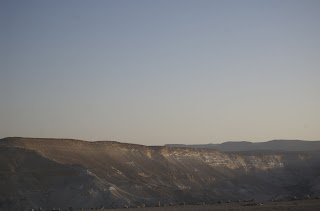
the view from Stay Boker

the view from Stay Boker

the sunset from Ben Gurion's Grave
Day 5: In the morning we went to Israel's first solar energy field, and met Professor David Faiman who is an expert on solar energy. So we toured the plant, and learned some about the ideas and technology behind it.
the energy plant
Then we went on another hike. The hikes prior to this one had been more like walks, but this one was a bit more intense, with some climbing and steep hills involved. The good news though; I didn't fall. Later that day after lunch we went to the city of Dimona where a group of African American Hebrews live. This was a group of people who identified themselves as the 13th tribe of Israel, and believed they were fulfilling Dr. King's ideals by settling in Israel. Most of them had come from the states (the older generation) while a lot of the younger people had been born in the community. These people were incredibly interesting; as I said they consider themselves Jews but not Jewish, and they abide strictly by the Torah. Which means they are on a raw vegan diet, they fast every Saturday, they do not ingest salt with their foods every other day, as well as many other things. Other interesting facts about their beliefs is that they believe in polygamy, are against drugs and alcohol, as well as anti-abortion and anti-gay. These last two point angered me and a few fellow students. They do not believe in pre-marital sex, so the anti-abortion idea doesn't exactly apply, but the anti-gay attitude is certainly applicable in their society. They expressed homosexuality as a choice or a decision, I believe they used the example, "if someone choose that path" as opposed to something that is instinctual (which is my belief). But aside from that, they were truly a fascinating community. There is no violence or crime within Dimona, and they are known as the city of peace. 
the energy plant
Day 6: This was our last morning at Kibbutz Stay Boker, so in the morning we packed up and headed to Kibbutz Ketura; an approx. three hour drive.
Sunday, October 11, 2009
Orienation and Arriving in Jerusalem
This is the introductory post to what will hopefully be a year long blog.
For the next 8 months I will be in Israel, studying and learning with a gap year program called KIVUNIM.
It is a program founded for the purpose of gaining a deeper understanding of the social conflict between Jews and Arabs, as well as experiencing Jewish life in Israel and by traveling to a variety of other countries including; Greece, Bulgaria, Spain, Turkey, India and more.
We arrived in Israel on October 1st, and then went to the desert for Orientation.
An overview of the next ten days is as follows.
Day 1: Hike, and tour and old synagogue as well as meet an woman who crafted things from Lulav leaves. She had made a hut entirely out of parts of the tree as well many baskets, rugs and other useful items. She helped us to make bracelets out of the reeds. The synagogue wasn't quite as cool, but it had a mosaic floor which was interesting. That evening was our first Shabbat together, and we had services and dinner, and we ate in the Sukkah at the youth hostel.
Day 2: Shabbats on this program are very low key, because while, the trip does not associate with one particular denomination of Judaism, it respects all beliefs, and there are many Modern Orthodox students on the trip. So we got to sleep late, and hang out. That evening there was Havdalah, and then later that evening we went on a Night Hike.
Day 2/3: Day 2 finished with a 6 hour hike through a canyon near Ein Gedi. We were led by this man names Yisrael, who was very spiritual and had spent a lot of time in the desert. We began the hike at about 11, and the plan was to climb out of the canyon in time to see the sunrise. Unfortunately, we didn't quite make it out in time to do that, and we were still walking when the sun rose, but we did get out by about 6, and were able to appreciate the early morning.
Day 3: We went back to the hostel for time to sleep and eat and then later that day we went to the dead sea spa, where we had time to spend in the sea.
Day 4: We left Ein Gedi, and headed to a Kibbutz called Stay Boker. Along the way we went to the Bedouin museum, to gain a little bit of knowledge about the culture and then we went to an unrecognized Bedouin village and met a woman named Amal (which means Hope in Arabic), who had been born into the Bedouin lifestyle and was unhappy with the roles that women were given. She has since spent much of her life trying to further women's roles in the culture, helping them to gain jobs and open their own businesses, all in a effort to make them feel more equal in society. We also met a man named Clinton Bailey who is the world's leading expert on Bedouin culture, and who knew Amal. Hearing about the Bedouin culture was incredibly fascinating; especially to hear Amal talk about all she's done, and how from an early age she didn't feel women's roles were correct was inspiring. After leaving the village we headed to Ben Gurion's home to tour it, and to learn a little bit about him. Then we went to the Kibbutz.
For the next 8 months I will be in Israel, studying and learning with a gap year program called KIVUNIM.
It is a program founded for the purpose of gaining a deeper understanding of the social conflict between Jews and Arabs, as well as experiencing Jewish life in Israel and by traveling to a variety of other countries including; Greece, Bulgaria, Spain, Turkey, India and more.
We arrived in Israel on October 1st, and then went to the desert for Orientation.
An overview of the next ten days is as follows.
Day 1: Hike, and tour and old synagogue as well as meet an woman who crafted things from Lulav leaves. She had made a hut entirely out of parts of the tree as well many baskets, rugs and other useful items. She helped us to make bracelets out of the reeds. The synagogue wasn't quite as cool, but it had a mosaic floor which was interesting. That evening was our first Shabbat together, and we had services and dinner, and we ate in the Sukkah at the youth hostel.
Day 2: Shabbats on this program are very low key, because while, the trip does not associate with one particular denomination of Judaism, it respects all beliefs, and there are many Modern Orthodox students on the trip. So we got to sleep late, and hang out. That evening there was Havdalah, and then later that evening we went on a Night Hike.
Day 2/3: Day 2 finished with a 6 hour hike through a canyon near Ein Gedi. We were led by this man names Yisrael, who was very spiritual and had spent a lot of time in the desert. We began the hike at about 11, and the plan was to climb out of the canyon in time to see the sunrise. Unfortunately, we didn't quite make it out in time to do that, and we were still walking when the sun rose, but we did get out by about 6, and were able to appreciate the early morning.
Day 3: We went back to the hostel for time to sleep and eat and then later that day we went to the dead sea spa, where we had time to spend in the sea.
Day 4: We left Ein Gedi, and headed to a Kibbutz called Stay Boker. Along the way we went to the Bedouin museum, to gain a little bit of knowledge about the culture and then we went to an unrecognized Bedouin village and met a woman named Amal (which means Hope in Arabic), who had been born into the Bedouin lifestyle and was unhappy with the roles that women were given. She has since spent much of her life trying to further women's roles in the culture, helping them to gain jobs and open their own businesses, all in a effort to make them feel more equal in society. We also met a man named Clinton Bailey who is the world's leading expert on Bedouin culture, and who knew Amal. Hearing about the Bedouin culture was incredibly fascinating; especially to hear Amal talk about all she's done, and how from an early age she didn't feel women's roles were correct was inspiring. After leaving the village we headed to Ben Gurion's home to tour it, and to learn a little bit about him. Then we went to the Kibbutz.

a small Bedouin hut in the unrecognized village
 Bedouin Children
 Bedouin Children
Subscribe to:
Posts (Atom)